
Introduction: The AI Race Is Changing
For a while, choosing an AI model was relatively straightforward. You opened ChatGPT, Claude, or Grok, entered a prompt, and judged the response based on how useful it seemed.
That approach is becoming increasingly inadequate.
The latest generation of AI models is being developed for considerably more demanding work: navigating large codebases, executing multi-step tasks, researching complicated subjects, interacting with external tools, and maintaining context across extended workflows.
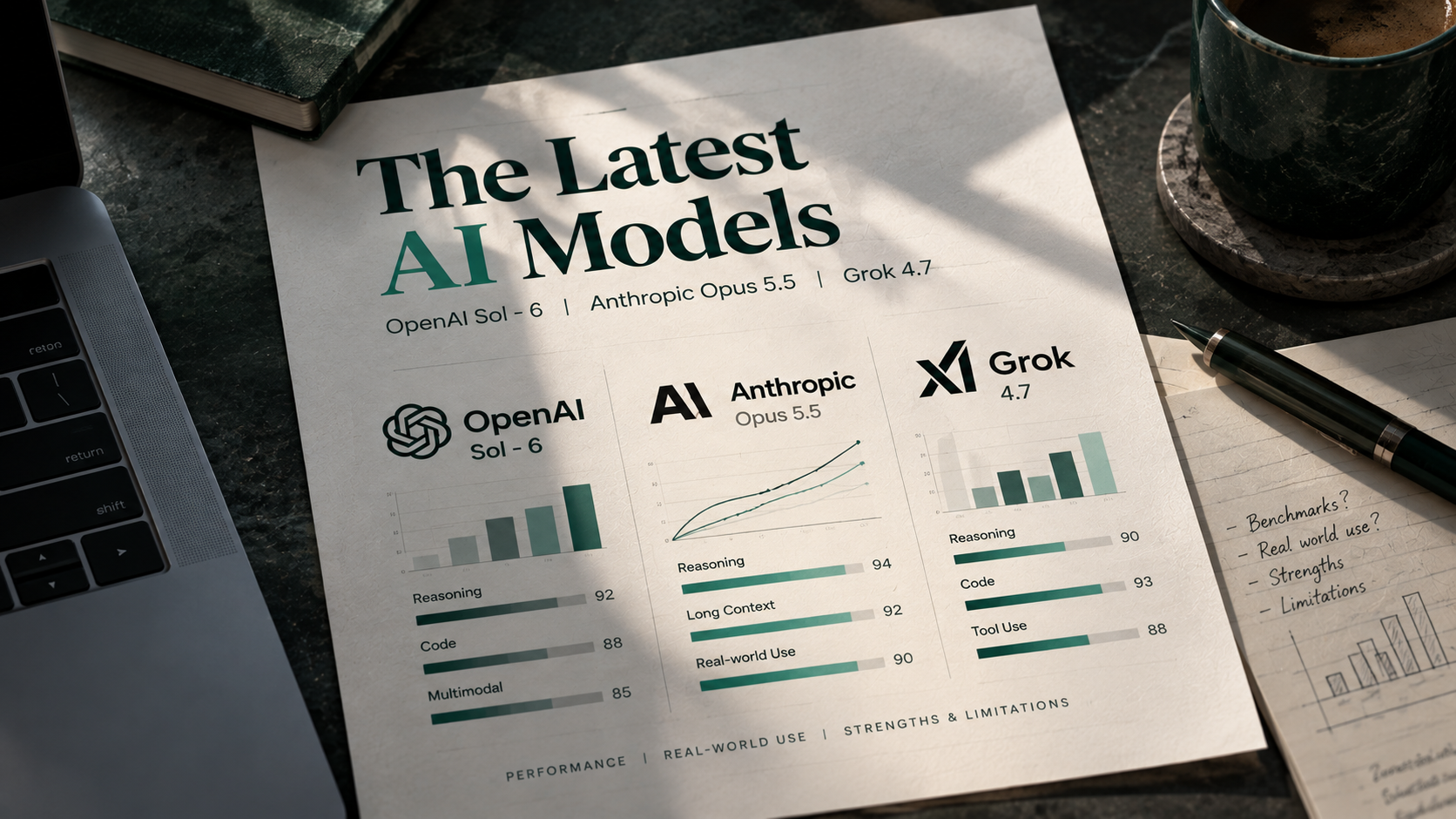
September 2026 brought three notable releases into focus: OpenAI's GPT-6 Sol, Anthropic's Claude Opus 5.5, and xAI's Grok 4.7.
Each release raises a similar question: how much of the advertised improvement translates into something genuinely useful?
For developers, businesses, and everyday users, the answer involves more than benchmark scores. Reliability, execution speed, operating costs, and the ability to complete tasks without constant intervention all matter.
This article examines the three models through their published performance results, technical capabilities, and emerging user discussions, with particular attention to what these developments mean outside controlled demonstrations.
Meet the Three Models
The three releases approach the increasingly competitive AI market with different priorities.
OpenAI GPT-6 Sol
OpenAI introduced GPT-6 Sol alongside GPT-6 Luna, expanding its GPT-6 family with models designed to balance advanced capabilities and operating costs.
Sol targets demanding professional tasks, including coding, reasoning, and agent-based workflows. Its release also reflects an important industry development: improvements in AI are increasingly being measured against the resources required to deliver them, rather than raw capability alone.
Anthropic Claude Opus 5.5
Released on September 22, Claude Opus 5.5 focuses heavily on coding, professional knowledge work, and long-running AI agents.
Anthropic reports improvements over Opus 5, alongside a 40% reduction in typical running costs and more than 30% faster output generation. The company also emphasizes clearer communication and better performance on large, complicated engineering tasks.
xAI Grok 4.7
Grok 4.7 represents xAI's latest update to its Grok model family, with reported improvements in coding and agent-related capabilities.
Its launch places considerable emphasis on cost competitiveness. However, lower API pricing alone does not establish lower total operating costs: token consumption, task completion rates, and execution time must also be considered.
The important distinction is that these are not simply three chatbots competing to produce the most convincing paragraph. They are increasingly sophisticated systems intended to perform actual work.
What Do the Official Benchmarks Actually Say?
Benchmark scores are useful, but they need context.
A model can perform exceptionally well in a controlled coding environment and still struggle with an unfamiliar production repository. Likewise, generating a correct answer is not necessarily the same as completing an entire workflow reliably.
Three evaluations are particularly relevant to this comparison.
Terminal-Bench 4.0 evaluates an AI agent's ability to complete complex, multi-step tasks through a command-line environment.
CursorBench 4.0 evaluates coding agents against realistic development tasks involving ambiguity, multiple files, and longer execution sequences.
DeepSWE v1.1 focuses on complex software-engineering problems in real codebases.
Published benchmark results
The following figures are taken from the companies' published evaluations. A dash indicates that a directly comparable result was not established in the reviewed release material.
Terminal-Bench 4.0
GPT-6 Sol: N/A
Claude Opus 5.5: 66.4%
Grok 4.7: 37.6%
CusrorBench 4.0
GPT - 6 Sol: N/A
Claude Opus 5.5: 57.8%
Grok 4.7: 46.3%
DeepSWE v1.1
GPT - 6 Sol: 68.8%
Claude Opus 5.5: N/A
Grok 4.7: 71.0%
hese figures represent reported configurations, not a single independently controlled experiment. Reasoning effort, agent harnesses, evaluation settings, and task costs can influence results.
For example, Anthropic reports Opus 5.5's 66.4% Terminal-Bench score at a high reasoning-effort configuration, while xAI reports Grok 4.7's 37.6% at xHigh effort.
A useful additional reference is OpenAI's GPT-5.6 Sol, which scored 37.3% on Terminal-Bench 4.0 in the published comparisons. This illustrates why comparing the correct model generation matters. GPT-5.6 Sol and GPT-6 Sol are different releases.
What should readers take away?
Rather than treating one benchmark as a universal measure of intelligence, look at what it evaluates.
A coding benchmark tells us something about software development. It does not automatically establish how effectively the same model writes marketing content, performs research, processes business documents, or handles customer support.
The more meaningful question is whether a model can repeatedly complete the specific tasks you need it to perform.
GPT-6 Sol: OpenAI's Focus on Capability and Efficiency
One of the more interesting aspects of GPT-6 Sol is that OpenAI is not positioning it as its most capable model overall. That distinction remains with GPT-6 Astra.
Instead, Sol is designed to bring newer-generation capabilities to users and developers at a more accessible operating cost.
Its published API pricing is:
- Input: $2 per million tokens.
- Output: $10 per million tokens.
- A 50% reduction from GPT-5.6 Sol's promotional pricing.
OpenAI also reports improvements in coding, professional workflows, computer interaction, and communication quality.
Why this matters for developers
Consider an AI coding agent working through an existing application.
It needs to understand the repository, identify relevant files, make changes, execute tests, and potentially repeat the process several times.
Every iteration consumes tokens. When these operations are performed repeatedly, the cost of an AI model becomes an architectural consideration rather than merely a subscription expense.
GPT-6 Sol's pricing gives teams more room to experiment with these workflows.
OpenAI reports a 68.8% score on DeepSWE v1.1 at maximum effort. The company also reports improvements in automation and computer-use evaluations compared with previous models.
Where it becomes relevant
Potential applications include software development assistance, document analysis, research workflows, structured data processing, and AI agents that interact with business applications.
However, using a capable model does not eliminate the need for proper application architecture.
An agent still requires permission boundaries, validated tool calls, error handling, monitoring, and human approval for consequential actions.
A better model can improve the execution layer. It does not automatically make the surrounding system production-ready.
Claude Opus 5.5: A Stronger Emphasis on Complex Engineering Work
Anthropic's latest Opus release places particular emphasis on tasks that require sustained attention across many steps.
These are often the jobs where AI assistance becomes frustrating: a model starts well, loses track of the original requirements, makes unrelated changes, or announces that a task is complete before properly validating the result.
Anthropic reports substantial improvements in these areas.
One early tester reportedly completed a migration involving 680,000 lines of code in less than a day. Another example involved auditing and fixing a 200,000-line codebase in under three hours.
These are company-reported examples from early testing, not guarantees of what every developer should expect.
What changed technically?
Opus 5.5 introduces improvements across several practical areas:
- Long-running coding and agentic workflows.
- Professional research and knowledge work.
- Output generation speed.
- Communication clarity.
- Operating costs and prompt caching.
Anthropic reports that the model generates output more than 30% faster than Opus 5 and costs approximately 40% less to run on typical workloads.
A particularly important improvement: communication
One aspect of AI performance that rarely receives enough attention is how models communicate during work.
A model might produce technically correct code but explain its decisions poorly, bury important information in excessive detail, or fail to communicate uncertainty.
Anthropic says Opus 5.5 was designed to address feedback about previous Claude models' writing style, with clearer and more natural responses.
This matters because developers and business users must understand what an AI system has done before trusting its output.
A capable agent that communicates its actions clearly is easier to review, debug, and integrate into an existing workflow.
Grok 4.7: More Capable AI at Competitive API Pricing
Grok 4.7 takes a slightly different approach to the same challenge.
xAI's September 21 release emphasizes coding, professional knowledge work, longer-running tasks, and cost efficiency.
According to its official announcement, the model uses a larger base model and a longer reinforcement-learning training process, with additional attention given to verifying its own work.
What do its benchmarks show?
xAI reports the following results:
CursorBench 4.0
Grok 4.6: 40.4%
Grok 4.7: 46.3%
DeepSWE v1.1
Grok 4.6: 65.2%
Grok 4.7: 71.0%
Terminal-Bench 4.0
Grok 4.6: 20.3%
Grok 4.7: 37.6%
EEBench
Grok 4.6: 53.0%
Grok 4.7: 64.0%
These are xAI's published results; the DeepSWE score for Grok 4.7 uses its high-effort configuration.
The Terminal-Bench improvement is particularly notable because it measures a form of extended task execution rather than a single conversational response.
Pricing and accessibility
Grok 4.7 starts at $2 per million input tokens and $6 per million output tokens.
Its official documentation also specifies a 500,000-token context window, support for structured outputs and function calling, and multiple reasoning-effort settings.
Long-context requests exceeding 200,000 input tokens have different pricing, so the headline API rate does not apply uniformly to every workload.
This makes Grok worth evaluating for teams whose applications involve substantial output generation, repeated processing, or long-running agents.
The caveat is that token pricing and actual cost per completed task are different measurements.
A model that uses more tokens, requires additional retries, or takes longer to finish a task may cost more operationally despite a lower advertised output-token rate.
What Are Actual Users Saying?
Official benchmarks tell us what models can accomplish under specific evaluation conditions.
Community discussions provide another perspective: how people experience these systems while building applications, debugging code, writing content, and handling everyday work.
For this article, we examined discussions from r/singularity, r/codex, r/ClaudeAI, and r/grok.
These comments are individual experiences, not statistically representative measurements. Nevertheless, they highlight practical concerns that benchmark tables often overlook.
r/codex: GPT-6 Sol and the cost-performance conversation
In a discussion titled
GPT-6 Sol Model, developers focused on pricing, coding performance, and how Sol compares with OpenAI's other releases.
Some users expressed interest in the possibility of achieving sufficient coding performance without paying for a more expensive model.
Others questioned whether benchmark improvements would translate equally well across different programming languages and less-common frameworks.
That second concern is particularly relevant.
A model that performs well on popular open-source repositories may behave differently when introduced to a proprietary enterprise application with unfamiliar conventions, incomplete documentation, or significant technical debt.
r/ClaudeAI: Positive early reactions to Opus 5.5
Claude's community has reported improvements in coding, interface debugging, and the model's ability to follow complex instructions.
In one discussion, a developer described noticeably faster identification of UI bugs using Opus 5.5 through Claude Code.
Another thread praised its ability to complete a creative project using existing assets with relatively little direction.
However, the feedback is not universally positive.
In another discussion, a user reported that Opus 5.5 handled certain resume-writing instructions less reliably than an earlier Claude release, despite improvements elsewhere.
This illustrates an important limitation of model upgrades: an improvement in general capabilities does not guarantee an improvement in every individual workflow.
r/grok: A divided response to Grok's direction
Discussions surrounding Grok 4.7 reveal a different concern.
Some users welcome its growing emphasis on coding and technical capabilities. Others miss the conversational personality and creative-writing experience associated with earlier releases.
In the Grok 4.7 announcement thread, several users expressed disappointment with the increasingly technical direction, while others described coding as an area where the model had become more useful.
This distinction matters because users do not necessarily evaluate AI models using the same criteria.
A developer may prioritize accurate code generation and task completion. A writer might care more about originality, tone, and the ability to maintain a consistent narrative.
Improving one does not automatically satisfy the other.
r/singularity: Greater scrutiny of benchmark claims
The broader AI community has also become increasingly interested in how benchmark results are presented.
In the Grok 4.7 launch discussion, users questioned chart presentation, unclear labels, and how to interpret comparisons between different models.
That skepticism is useful.
As the competition becomes more intense, readers should distinguish between independent evaluations, vendor-reported measurements, demonstrations, and personal experiences.
All four can provide information, but they answer different questions.
API Pricing: What Does It Actually Cost to Use These Models?
For companies integrating AI into products, pricing can be just as important as model capabilities.
A subscription may be sufficient for individual use, but production applications generally operate through APIs, where costs depend on usage.
Published standard API pricing
USD per million tokens, September 2026
GPT-6 Sol
Input: $2.00
Output: $10.00
Claude Opus 5.5
Input: $4.00
Output: $20.00
Grok 4.7
Input: $2.00
Output: $6.00
These are base rates. Caching, long-context pricing, regional inference, and other usage conditions may affect the final bill.
Why cost per completed task matters more
Imagine an AI agent processing a customer support request.
The process might involve identifying the customer, retrieving previous conversations, checking an order, updating a CRM, and preparing a response.
The model may need several tool calls and reasoning steps before completing the workflow.
The actual operational cost depends on:
How many tokens are consumed.
- Whether previous context can be cached.
- How many tool calls and retries are required.
- Whether the task succeeds without human intervention.
- How long the entire process takes.
A model with lower token pricing may not necessarily deliver a lower cost per successful workflow.
For businesses evaluating AI automation, measuring complete task execution provides a more useful basis for procurement than comparing API pricing in isolation.
Which AI Model Should You Use for Different Tasks?
There is no universal answer, because different applications have different requirements.
The available evidence suggests several areas worth testing for each model.
- Large Codebase migrations: Opus 5.5, GPT-6 Sol
- Coding Assistants: All Three
- Business Automation: Opus 5.5, GPT-6 Sol
- Research and documentation: All Three
- High-Volume API workloads: GPT-6 Sol
- Long-Running AI Agents: GPT-6 Sol, Opus 5.5
These are suggested evaluation candidates, not a ranking of overall model quality.
The strongest approach is to test each model against the actual workload it will support.
For example, if you are developing a CRM automation agent, create a repeatable set of tasks using anonymized records. Give every model the same instructions, tools, permissions, and success criteria.
Measure how often it completes the task, how frequently it makes incorrect updates, and how much each successful execution costs.
That experiment will tell you considerably more about your application than a general-purpose AI leaderboard.
What These Releases Mean for Businesses and Developers
The broader significance of these releases extends beyond which company produces the most impressive benchmark chart.
Three developments deserve attention.
1. AI agents are becoming more practical
AI systems are increasingly designed to execute sequences of actions rather than simply generate responses.
For businesses, this creates opportunities in customer relationship management, reporting, document processing, internal operations, and software development.
However, deployment quality still depends heavily on the surrounding infrastructure.
2. Model efficiency is becoming a competitive factor
The reduction in API pricing across recent releases makes advanced models more accessible for repeated use.
This could make previously expensive workflows economically viable, particularly when combined with caching and careful model selection.
3. Evaluation needs to become application-specific
Businesses should avoid selecting a model solely because it recently launched or performed well in a public benchmark.
A more reliable evaluation process considers correctness, consistency, latency, integration requirements, security, and total cost.
For production systems, the objective should be predictable performance over time rather than an impressive demonstration on launch day.
Final Thoughts: The Next Stage of AI Is About Getting Work Done
GPT-6 Sol, Claude Opus 5.5, and Grok 4.7 demonstrate how quickly AI development is moving beyond conventional chatbot functionality.
OpenAI is bringing newer-generation capabilities into more cost-efficient models. Anthropic is investing heavily in sustained engineering and professional workflows. xAI is improving its coding and agent capabilities while maintaining competitive API pricing.
Their published benchmarks show meaningful progress, but they also reinforce an important point: AI performance cannot be reduced to a single number.
The most useful model is the one that can consistently complete the work it has been assigned, within acceptable cost, time, and reliability constraints.
For developers, that means testing against real repositories and realistic tasks. For businesses, it means evaluating complete workflows rather than isolated prompts.
And for everyday users, it means looking beyond model announcements and paying attention to what actually improves their experience.
The next stage of AI adoption will depend not only on how intelligent these systems become, but on how reliably we can put that intelligence to work.