
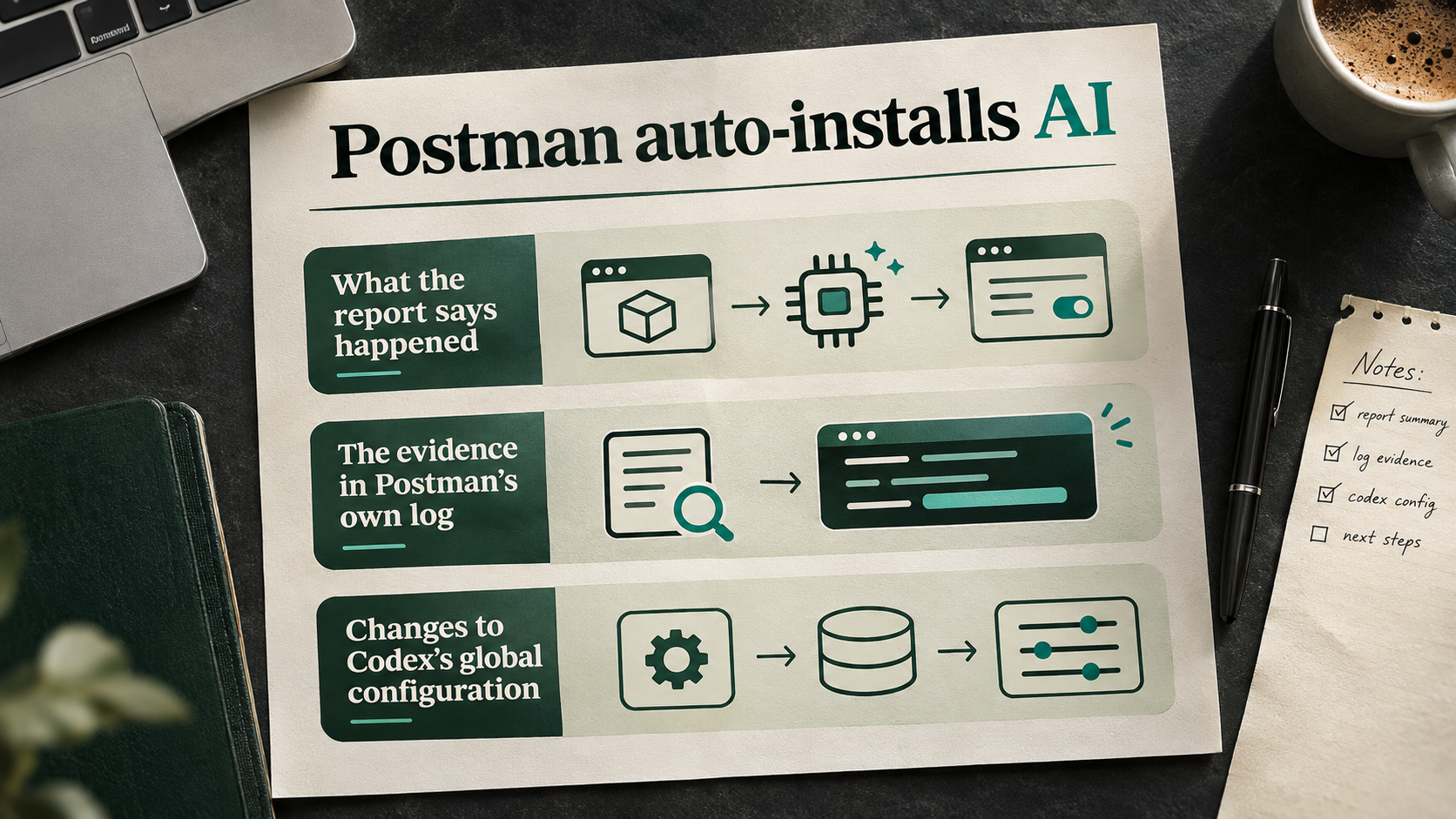
A user has filed a detailed GitHub issue against Postman, reporting that the Postman desktop app on a Mac changed their coding agents without asking. According to the report, opening Postman was followed by several changes: plugins appeared in both Codex and Claude Code, a hook that runs at startup was added, a remote MCP connection was created, and a separate command-line tool was installed.
The reporter calls this a serious consent and trust-boundary problem. They also state clearly that the report does not show data exfiltration, which is worth keeping in mind when reading the issue's title. This post walks through what the issue documents, what remains unproven, and what developers and technical leads can check on their own machines.
What the report says happened
The reporter describes an existing Postman desktop installation that they opened after not using it for a while. Afterwards, they saw recurring MCP authentication warnings in their coding tools. Codex also kept routing API-related tasks through Postman skills.
MCP (Model Context Protocol) is a standard way for AI agents to connect to outside tools and services. A "skill" is a packaged set of instructions an agent can load for a certain kind of task. A "hook" is a command that runs automatically at a defined moment, such as when a session starts.
On investigating, the reporter found five things on the machine:
- A user-wide Postman plugin in Codex.
- A hook that feeds instructions to the agent when a session starts.
- A connection to a remote MCP server.
- A plugin for Claude Code.
- A separately installed Postman CLI.
The versions listed are Postman desktop 12.33.4, Codex plugin 1.1.0 and Claude plugin 2.0.1. The reporter says the investigation took place on October 25, 2026, and that they removed the local Postman installation and integrations afterwards, having preserved the evidence first.
The evidence in Postman's own log
The most pointed part of the report is a pair of entries from Postman's own application log on macOS. The entries are timestamped October 24, 2026, at 09:34 UTC. They record an install with the source label auto-existing-upgrade and a result that lists both claude-code:installed and codex:installed.
A second entry describes an automatic installation for an existing user. It records the outcome as installed, the platform as darwin (macOS), and notes that the user was signed in.
The Claude Code records line up with this. The reporter says the plugin's install record shows the same time window, with an installed-at and last-updated time of 09:34:02 UTC on October 24. They also say the Postman executable and its library folder in ~/.local/bin have modification times matching that window.
Taken together, the reporter argues, this means the installs were triggered by the app itself rather than by a deliberate user action. The reporter asks Postman to identify the exact release or feature flag behind the auto-existing-upgrade label.
Changes to Codex's global configuration
The reporter shows that Codex's global user configuration file was changed. It gained a marketplace entry pointing to a Postman plugin repository on GitHub, an entry enabling the Postman plugin, and a hook state entry containing trusted hash values.
Because this file is global to the user, the change applies across projects rather than to one repository. That is the core of the complaint: one application edited the settings of a different tool, for the whole user account.
The startup hook and its broad scope
The installed hook registers a command that runs when a Codex session starts, clears or compacts. The command prints a context file into the agent's instructions. According to the reporter, one instruction in that file tells the agent to load a Postman API engineering skill before it responds to any non-trivial API engineering task. The listed examples include designing, implementing, mocking, testing, monitoring, documenting and deploying an API or a Postman Flow.
The reporter says this explains why Codex kept announcing Postman skills. They also argue it is much wider than a user explicitly asking to use Postman. In practice, a developer who simply asked an agent for help with an API could find the agent steered toward one vendor's workflow.
The hook approves itself
The reporter also reviewed the installer's source code. They say the Codex installer calls a function that approves Postman's hook after the plugin is installed. According to the report, the code reads the hook's hash through a hook listing call and then writes it into the trusted state in the configuration through a batch write call. A source comment describes this as approving only Postman's current hook after installation.
The reporter objects to an installer approving its own hook, and argues that hook trust should be decided by the user inside the agent host.
The reporter is careful here. They say the source code establishes that an approval attempt exists, but the trust record in the configuration does not prove who created that specific record. They therefore do not present it as proof of any particular user interaction.
A remote MCP connection that could not authenticate
The plugin's MCP configuration points to Postman's hosted MCP endpoint. According to the reporter, the Codex logs show that the server failed at startup because authentication was required. So the connection was enabled but not working, which produced the repeated warnings that first alerted them.
What the report does not claim
The issue's title mentions attempts to share API data, but the body is narrower than that. The reporter writes that the report establishes unwanted integration and instruction changes and does not claim to establish data exfiltration.
The reporter also says the sequence is an observation from one Mac and has not yet been reproduced on a clean machine. They excluded private paths, unrelated logs, account identifiers and credentials from the evidence. Readers should treat the findings as a detailed single-user report, not as a confirmed, vendor-acknowledged incident. The issue as quoted here shows no response from Postman.
What the reporter is asking Postman to do
The issue lists specific requests:
- Stop automatic agent-plugin and CLI installation for existing desktop users until they explicitly opt in.
- Remove the installer's self-approval of hooks, so that hook trust is decided by the user inside the agent host.
- Name the release or feature flag behind
auto-existing-upgrade, explain how users are asked for consent, and list which other agents and files the process is able to modify. - Offer a full uninstall and rollback route that cleans up agent settings, hook trust, marketplaces, caches, MCP connections and the CLI, and honour a removal instead of reinstalling.
- Narrow the startup instructions to explicit Postman requests instead of making Postman the default for general API work.
The reporter asked for maintainer triage at severe priority, noting that they cannot assign repository labels themselves. The issue page also shows reactions from other users, with one group listing more than 200 names. The source gives only the names and counts, not what the reactions mean.
What this means for businesses and developers
Whatever Postman's response turns out to be, the report is a useful prompt to audit how AI coding agents are configured on your machines. Practical steps:
- Review global agent configuration. Check files such as
~/.codex/config.tomland~/.claude/settings.jsonfor marketplaces, plugins or hook entries you do not remember adding. - Look at installed plugin records. For Claude Code, the installed plugins file shows each plugin, its scope and the time it was installed. Compare those times with when you last opened other desktop tools.
- Inspect hooks before trusting them. A session-start hook can add instructions to every agent session. Read what it prints and decide whether you want it.
- Check for unexpected command-line tools. Look in directories such as
~/.local/binfor executables you did not install yourself. - Read application logs when something changes. In this case Postman's own log recorded the install source, which gave the reporter a clear timeline.
- Set a team policy. If your team uses shared machines or managed laptops, decide who may add plugins and MCP connections to coding agents, and how that is reviewed.
Back up a configuration file before you edit it, and keep notes on what you changed, so that you can restore a working setup.
Final thoughts
The core question in this report is consent: should one application be able to install itself into other tools, and approve its own startup hook, because a user opened it? The reporter says no. Postman's own account of the auto-existing-upgrade behaviour is still the missing piece.
Until the vendor responds and the findings are reproduced, it is sensible to treat this as a credible but single-source report. It is also a good moment to look at what your own coding agents are loading at startup.